
Posted by:
idiot
Can someone please tell me how many miles the route is 1 way? Struggling to find online.
Forum
Arriva North East
Posted by:
Storx
Just thought I'd start a thread on this as it's something which has come up once in awhile and is continued to be promised to be improved but nothing is changing.
Haymarket Bus Station tonight (at around 7pm) was an absolute disgrace; drunks shouting abuse at people outside the Junction, homeless people sleeping in the doorway of M&S, drunks just wandering around causing issues between the stands (no doubt begging again) and it's not even late.
Absolutely disgusting for a major city centre bus station with absolutely zero security - I'm convinced this place used to have management on 24/7 even if he sat in the booth at the Eldon Square end.
First time I've left, and jumped on the Metro for a few stops and waited at South Gosforth instead as I couldn't be chewed with the hassle for 20 minutes (mistimed it) and I'm not a vulnerable pensioner, young or a woman who imo are more at risk - Kim McGuinness likes to tell everyone at every chance, at least anyway.
It's not a unique scenario as I know Stanley is a war zone, Blakelaw currently hasn't zero buses, Meadowell is regularly having buses pulled, the Metro is as bad as it's ever been and I'm sure that list could go on.
Surely something has been done now? Not with franchising in god knows whenever it is. It's a complete mess and worse than I can ever remember. There's no excuse for zero visible staff in either Haymarket Metro or Haymarket Bus Station imo.
Haymarket Bus Station tonight (at around 7pm) was an absolute disgrace; drunks shouting abuse at people outside the Junction, homeless people sleeping in the doorway of M&S, drunks just wandering around causing issues between the stands (no doubt begging again) and it's not even late.
Absolutely disgusting for a major city centre bus station with absolutely zero security - I'm convinced this place used to have management on 24/7 even if he sat in the booth at the Eldon Square end.
First time I've left, and jumped on the Metro for a few stops and waited at South Gosforth instead as I couldn't be chewed with the hassle for 20 minutes (mistimed it) and I'm not a vulnerable pensioner, young or a woman who imo are more at risk - Kim McGuinness likes to tell everyone at every chance, at least anyway.
It's not a unique scenario as I know Stanley is a war zone, Blakelaw currently hasn't zero buses, Meadowell is regularly having buses pulled, the Metro is as bad as it's ever been and I'm sure that list could go on.
Surely something has been done now? Not with franchising in god knows whenever it is. It's a complete mess and worse than I can ever remember. There's no excuse for zero visible staff in either Haymarket Metro or Haymarket Bus Station imo.
Posted by:
L469 YVK
Just thought about this......but why did Arriva specify the Dennis Trident instead of the DAF DB250 for regional ALX400 orders in 2000 including 7340-35 for the 602 out of Hexham?
I know Northumbria trialed the DAF DB250 Optare Spectra (as they already had Deltas) before choosing the Cummins engined Volvo Olympian Palatine II's.
Surely the DAF DB250 chassis for regionals would've been better than the Dennis Trident chassis given that Hexham's batch needed to be replaced by B10BLE's.
Ironically a year later despite the Lowlander bodywork, Arriva did switch to the DAF DB250 chassis for regional orders which included the Darlington batch for the 723.
I know Northumbria trialed the DAF DB250 Optare Spectra (as they already had Deltas) before choosing the Cummins engined Volvo Olympian Palatine II's.
Surely the DAF DB250 chassis for regionals would've been better than the Dennis Trident chassis given that Hexham's batch needed to be replaced by B10BLE's.
Ironically a year later despite the Lowlander bodywork, Arriva did switch to the DAF DB250 chassis for regional orders which included the Darlington batch for the 723.

Posted by:
Adrian
NEMSA Cabinet released the long-awaited North East Rail Vision at Tuesday's cabinet meeting, which is a high-level visionary document which sets out the Mayor’s priorities
for rail in the region up to 2040.
The vision is supposed to set out the practical steps needed to deliver change, which NEMSA include:
I've added links to some of the key documents below:
North East Rail Vision Report to Cabinet
Appendix A - North East Rail Vision, summary document
Appendix B - North East Rail Vision
Appendix C - Washington Metro and Leamside South
The key things that I've noted are that there's an immediate desire to bring in local rail part of the 'Angel Network', integrated buses, Metro and other modes. Long term ambitions are the Leamside in full (which we knew about), and extending other lines to either increase capacity or link other places. Northumberland Line being one, with the plan to open up to Newbiggin-by-the-Sea. There's references to building up a project pipeline, which returns again to reopening passenger services on the Stillington Branch and Ferryhill station, but also the Bensham Curve.
for rail in the region up to 2040.
The vision is supposed to set out the practical steps needed to deliver change, which NEMSA include:
- Stronger partnerships with GBR, wider rail industry partners, Local Authorities and other stakeholders to ensure priorities are clear and plans are aligned.
- Joined-up planning to ensure rail investment aligns with wider regional goals.1
- Reliable funding, both multi-year devolved financial settlements and long-term infrastructure funding commitments from Department for Transport and GBR.
- A clear phased roadmap of improvements to 2040, to ensure funding can be used in a timely and targeted way.
I've added links to some of the key documents below:
North East Rail Vision Report to Cabinet
Appendix A - North East Rail Vision, summary document
Appendix B - North East Rail Vision
Appendix C - Washington Metro and Leamside South
The key things that I've noted are that there's an immediate desire to bring in local rail part of the 'Angel Network', integrated buses, Metro and other modes. Long term ambitions are the Leamside in full (which we knew about), and extending other lines to either increase capacity or link other places. Northumberland Line being one, with the plan to open up to Newbiggin-by-the-Sea. There's references to building up a project pipeline, which returns again to reopening passenger services on the Stillington Branch and Ferryhill station, but also the Bensham Curve.
Posted by:
EastGatesheadRider
I made this so everyone can have fun on the website
Everyday a bus will be eliminated
Try pick a niche once because the easy ones will be out first
Everyday a bus will be eliminated
Try pick a niche once because the easy ones will be out first
Forum
General Discussion
Posted by:
Malarkey
Wear Bus Preservation Group have this evening announced yet another Ex Go North East into Preservation in Optare V1110 Optare Versa 8307 (NK09 FVG) which has came back to the North East following the collapse of independent operator C4TN.
8307 joins other group current fleet members:
- First York 11113 / BG58 OMJ
- Go North East 5264 / NK56 KJZ
- Go North East 4950 / NK51 OLR
- Go North East 3942 / NK05 GZP (part owned)
- Arriva North East 4718 / YJ10 DFU
- Go North East 3895 / NK51 UCY
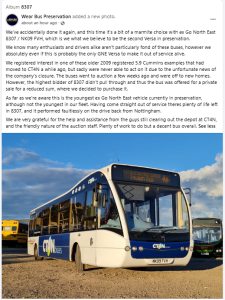
8307 joins other group current fleet members:
- First York 11113 / BG58 OMJ
- Go North East 5264 / NK56 KJZ
- Go North East 4950 / NK51 OLR
- Go North East 3942 / NK05 GZP (part owned)
- Arriva North East 4718 / YJ10 DFU
- Go North East 3895 / NK51 UCY
0
Posted by:
Storx
Does anyone know what's going on with Ashington tonight, there's some nasty gaps floating around especially the 2.5 hour gap on the X21 leaving Newcastle and the 35 is every 2 hours, as of writing?
Assume it's not fleet related at this time of night. I know there was talk of other depots bailing out the Stockton mess but they can't be stupid enough to cause massive issues elsewhere to bail out another depot?
Assume it's not fleet related at this time of night. I know there was talk of other depots bailing out the Stockton mess but they can't be stupid enough to cause massive issues elsewhere to bail out another depot?
Forum
Arriva North East
Posted by:
Michael
25 Oct 2026:
PB0003954/823
Variation GO NORTH EAST LIMITED X10 Newcastle Peterlee
PB0003954/824
Variation GO NORTH EAST LIMITED X10 Peterlee Middlesbrough
PB0003954/823
Variation GO NORTH EAST LIMITED X10 Newcastle Peterlee
PB0003954/824
Variation GO NORTH EAST LIMITED X10 Peterlee Middlesbrough
Forum
Go North East
Posted by:
Retro Nero
Does anyone know or realise that at Villette Road / Ryhope Road junction, (in Sunderland) it still has the original bus shelter concrete cannopy where Sunderland Corporation used to terminate (Villette Road Terminus) , Pre 1970s
Posted by:
Malarkey
Looks like Arriva are going to be conducting a UK wide survey regarding there services within there operational areas over the coming months.
Arriva Buses Wales new Wright Streetdeck Ultroliners (BN76 CPU) has received vinyl's for the campaign.
https://flickr.com/photos/cymrucoastline...1819684594
Arriva Buses Wales new Wright Streetdeck Ultroliners (BN76 CPU) has received vinyl's for the campaign.
https://flickr.com/photos/cymrucoastline...1819684594
Forum
Arriva North East
Welcome, Guest
Search
Statistics
Latest Threads
Go North East - State of ...
Last Post:
Storx
•
2 hours ago
Scotland Bus Operations
Last Post:
citaro5284
•
2 hours ago
X18
Last Post:
NorthEastern
•
3 hours ago
Arriva State of The Fleet
Last Post:
davao123
•
3 hours ago
Go North East - 2025 Pote...
Last Post:
TransitObserver
•
4 hours ago
Durham County Council
Last Post:
220631612
•
8 hours ago
East Coast Main Line
Last Post:
markydh
•
Yesterday, 9:38 pm
Safety On North East Tran...
Last Post:
Storx
•
Yesterday, 9:34 pm
Stockton Depot
Last Post:
Mike_98
•
Yesterday, 8:24 pm
The North East Rail Visio...
Last Post:
V514DFT
•
Yesterday, 4:13 pm